Award-winning engineering in the heart of Berlin
October 13, 2026 | Moritz Glück
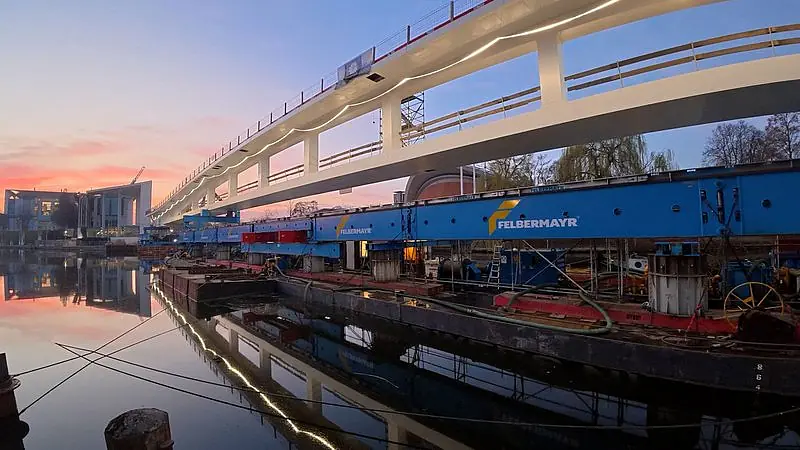
In the middle of Berlin's government district, framed by the Spree, the Chancellery and urban life, a building was set in motion in a three-part act which, in addition to its dimensions, was particularly impressive due to the way in which it found its place.
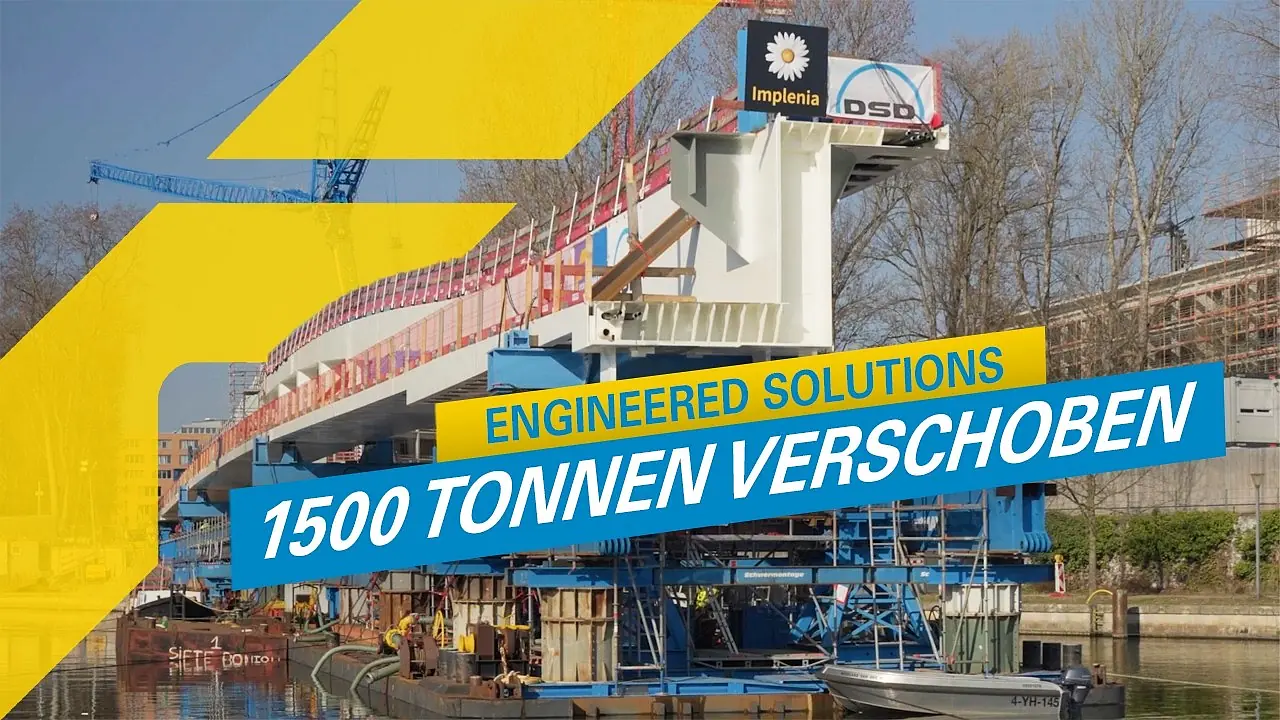
“185 meters long, 6 meters high and wide, and weighs around 1,500 tons — the south bridge was no ordinary project in itself. And the Spree also played its part, so it certainly wasn't boring for us. Meter by meter, we moved the bridge across the water until it reached its final position,” explains Engineered Solutions Project Manager Jens Fuchs.
Bridge with character
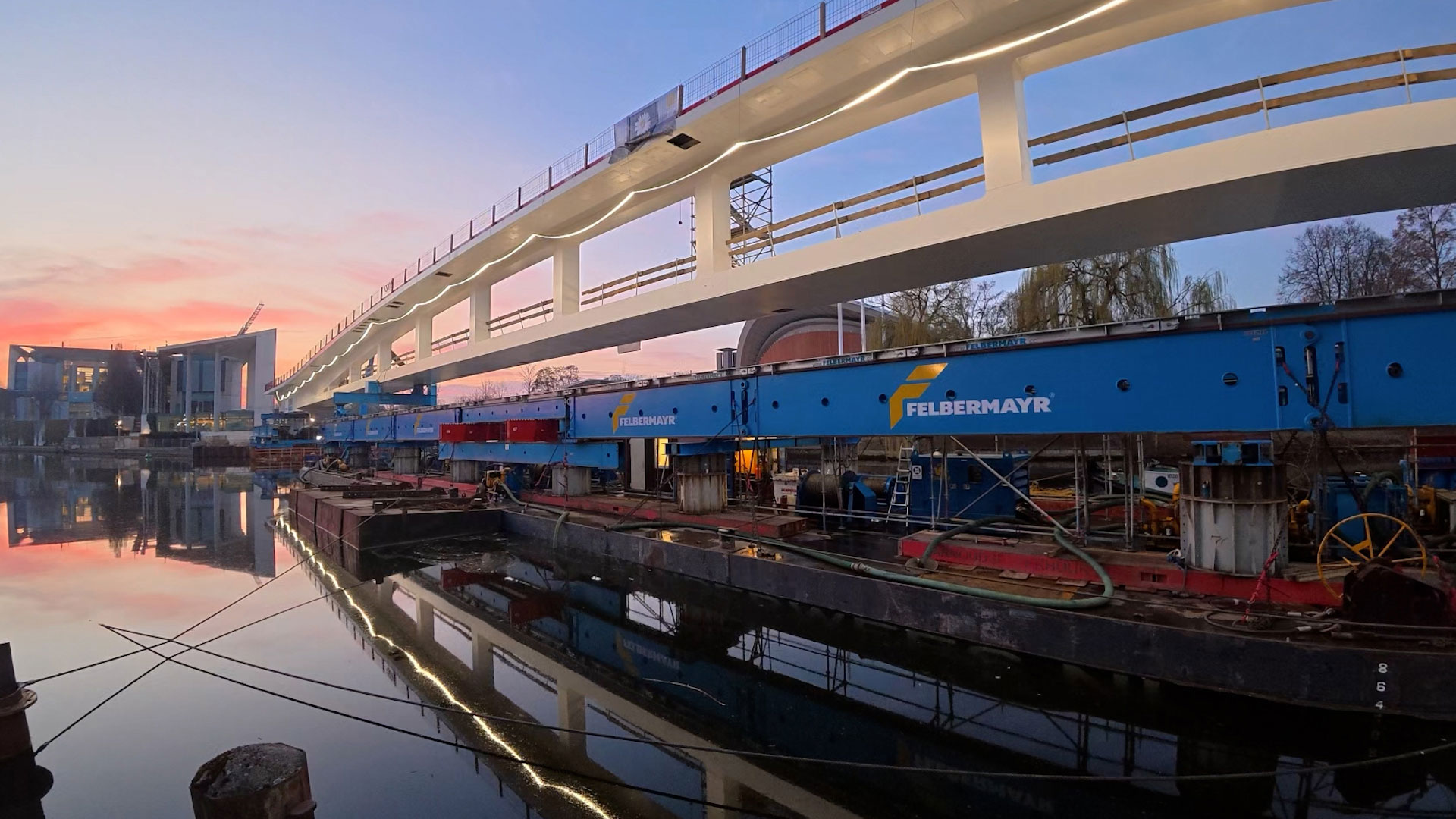
The special feature of the steel bridge is reflected in a distinctive Z-shape — an architecturally sophisticated solution that entailed considerable technical challenges. “While the center of gravity of other bridges is in the middle, it is difficult to handle with a Z-construction,” explains Fuchs and continues: “As a result, the bridge tends to twist. This was precisely one of the biggest hurdles. We had to design the entire concept so that the loads constantly change during the shift. At the same time, the four crossbeams on which the bridge was supported were allowed to differ in height by a maximum of two centimeters upwards and two centimeters downwards. ”
For the engineers wearing sky blue outfits, this meant maximum precision — from planning to implementation. However, the particular shape was no accident. The existing north bridge already has this geometry — the new south bridge deliberately follows this construction and thus fits into the overall architectural image of the federal capital.
First act
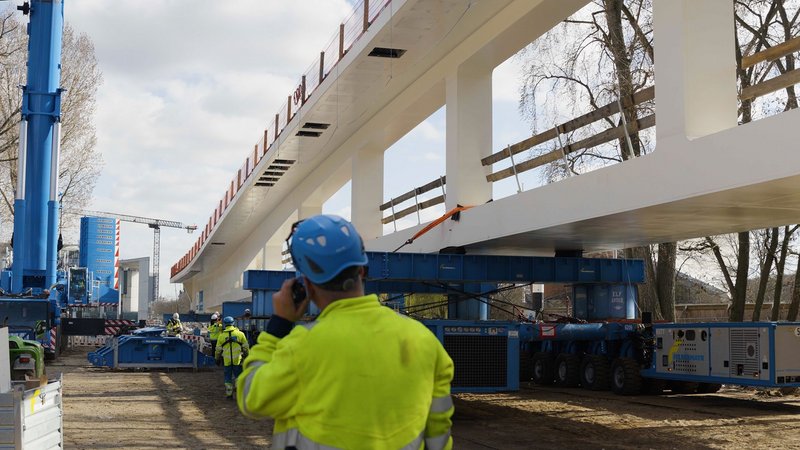
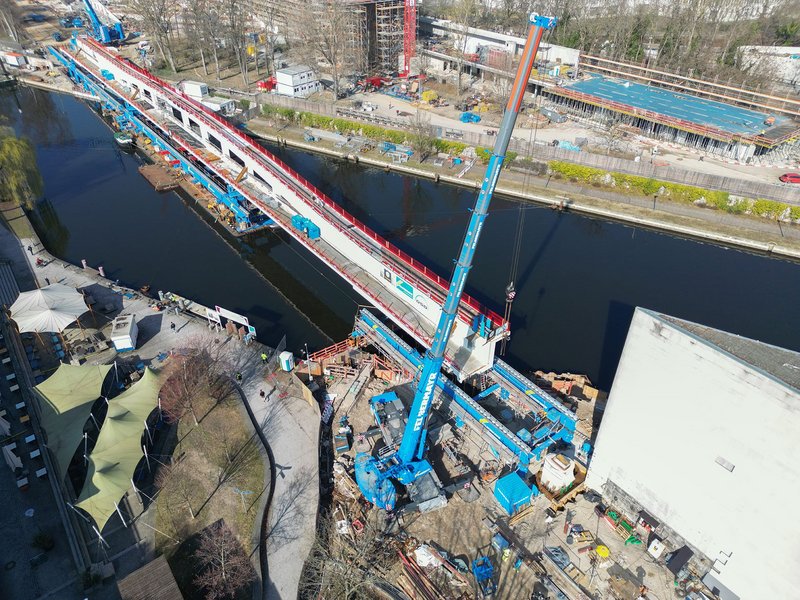
weeks before the bridge set in motion, preparations were already in full swing. Without further ado, the Kanzlerpark became an inner-city construction site, where complex logistics services were provided in confined spaces. The south bridge first had to be assembled and welded from individual segments on the construction site before it could later be set in motion as an entire unit. The four massive crossbars formed the basis for storage on a specially constructed sliding track. The bridge was picked up at these points. With so-called step lifters, the steel body was lifted with millimetre accuracy before the mounting brackets were then removed and the way was opened for three sets with a total of 68 axles. SPMT More than 1,000 tons of equipment were used for the relocation.
Technology that moves
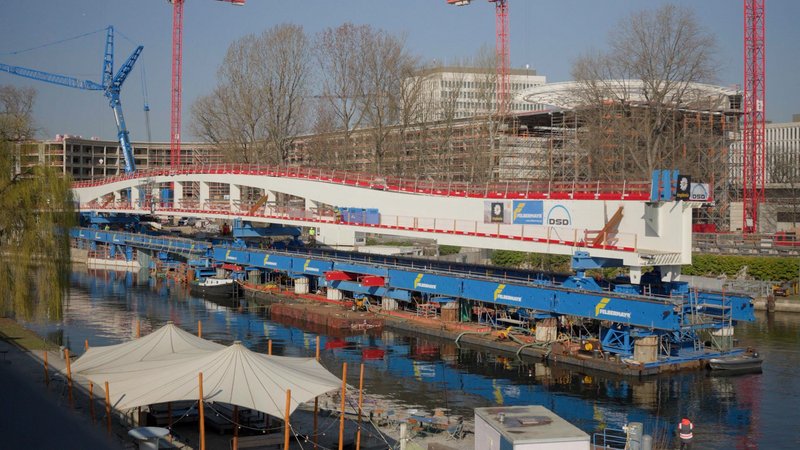
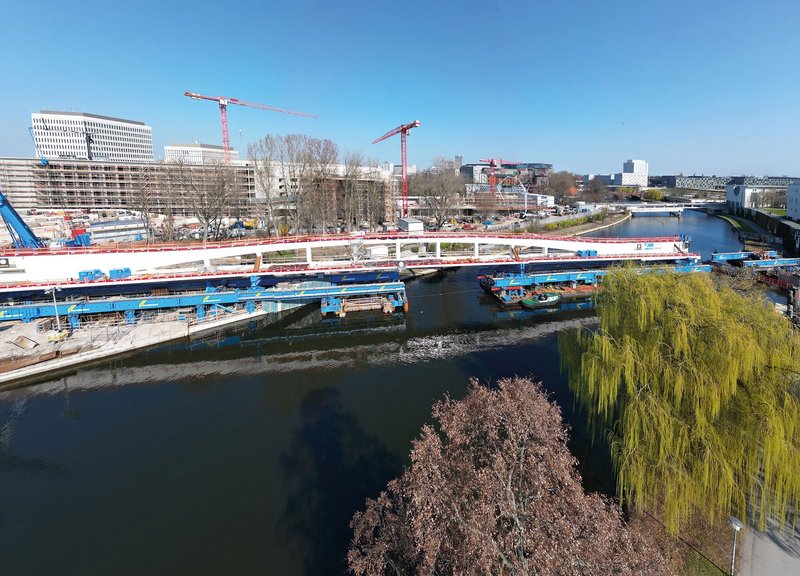
The actual shift was a perfectly coordinated composition of different systems. On the landside, the bridge stored on the SPMTs was led over an approximately 60 meter long sliding track from Kanzlerpark to the banks of the Spree. This movement continued across the water on a pontoon and carried the structure further towards the Chancellery. The railway was used to ensure that the south bridge could be kept safely on track while running. “Each work step had to be precisely planned and executed. There was no room for improvisation,” says Fuchs, describing the situation: “In the center of the metropolis, in front of the entire city, moving a bridge like this continuously and at the same time maintaining control of the load distribution and the minimal differences in the height of the crossbeams makes you sweat a bit. ”
Technical excellence
“The most spectacular moment was when the bridge reached the Spree. While the rear part of the bridge was still resting on the banks of Magnus-Hirschfeld, several hundred tons of steel were already pushed across the water via the sliding track positioned on the pontoon in the Spree,” Fuchs describes the demanding passage and notes: “It is this moment that you work towards for months, in which everything stands still and you pause briefly before the colossal construction glides across the water. ”
As soon as the first of the two received crossbeams reached the second, based on dolphins, on the banks of the Chancellery, the pontoon was only partially loaded with one crossbeam and could reset. In doing so, it became demanding once again. The pontoon had to be pulled back under the second crossbeam in a controlled manner. The extremely slight difference in height of the crossbeam resting on the pontoon made this manoeuvre a particular challenge.
The plot of this “heroic epic” took place in a closely timed time window of just 72 hours. The protagonists from Krefeld worked around the clock in 24-hour operation. Ten men per shift ensured that the masterly production could proceed without a break. “What sounds like just a few hours of work was the result of two years of planning and preparation. In the end, everything is decided in these few but decisive moments,” says Fuchs. “That's when the choreography has to go smoothly. ”
In the heart of Berlin
The construction work in the Kanzlerpark offered the specialists from Engineered Solutions hardly any leeway — in terms of space, logistics and time. Narrow roads, winding access roads and the volume of traffic in a metropolis made the delivery of the required major components correspondingly complex. At the beginning of the year, the picture of the south bridge was finally put together piece by piece over several weeks like a collage.
The project was also supported by crane technology from the Felbermayr branches in Bautzen and Dresden. A 230-ton and a 650-ton mobile crane became hammer and chisel — and allowed the construction to take shape step by step.
A project that combines
With the completion of the work, the new south bridge blends picturesquely into Berlin's government district, strengthens infrastructural development and creates an additional connection across the Spree. With this project, the experts from Engineered Solutions are once again showing what expertise and engineering know-how the Felbermayr Group has to offer. “The south bridge shows what we are capable of. We create unique and sustainable solutions in the truest sense of the word. There are no tasks that are too big for us — just those that have not yet been thought through to the end,” says Fuchs about the project, which leaves a fine line in the heart of the city with millions of inhabitants and combines technical and artistic perfection in equal measure.