Charging crane successfully positioned
September 30, 2026 | Moritz Glück
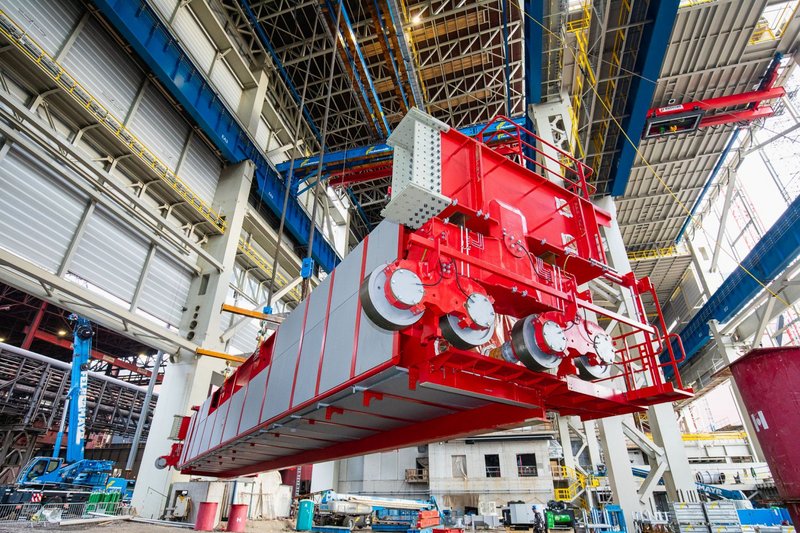
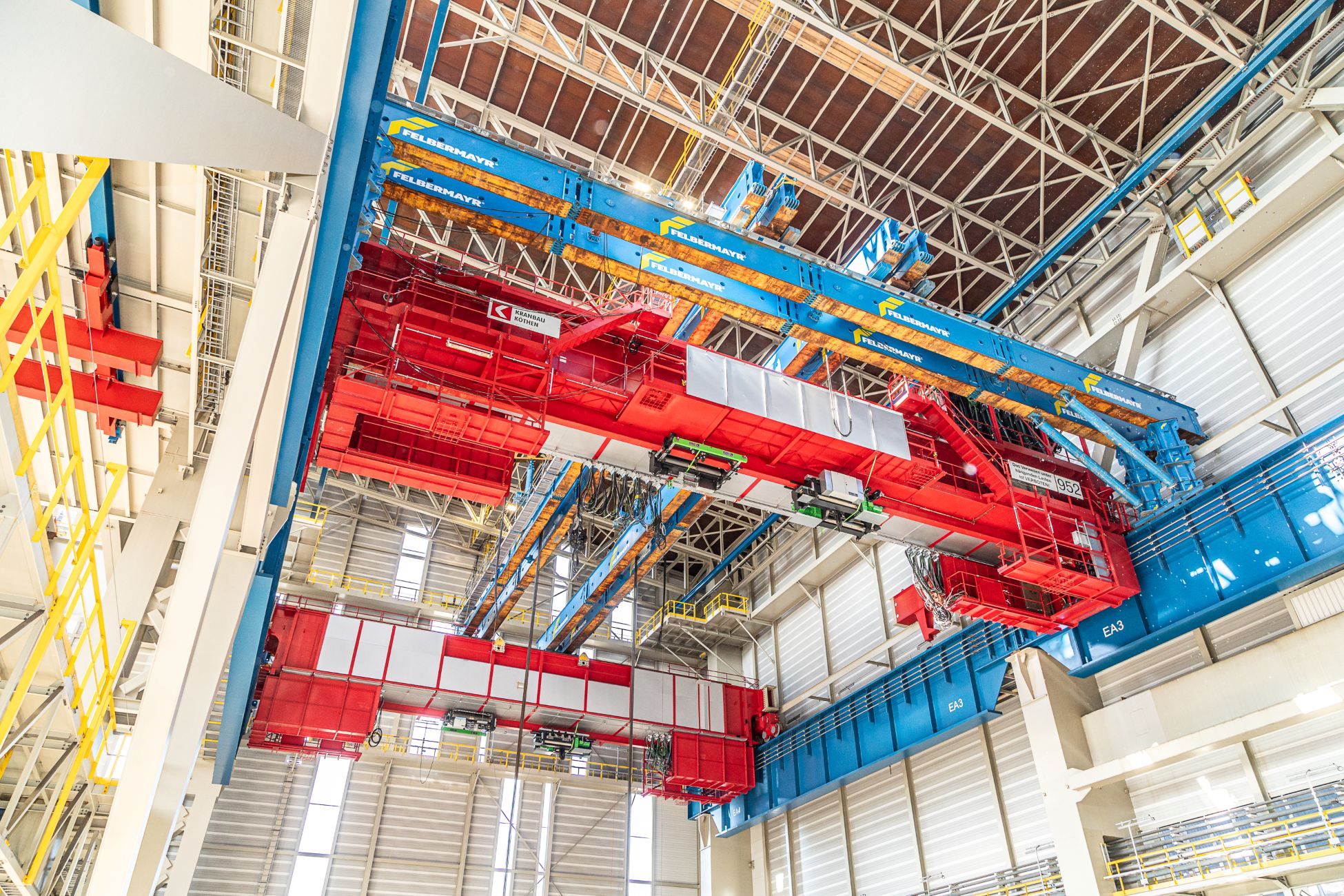
The two 170 and 204 ton main girders had to be assembled in tight spaces. Both on the ground and under the roof of the 65-meter high electric arc furnace hall, the Engineered Solutions team had little leeway. “The project was comparable to moving, in which you had to maneuver pieces of furniture through a stairwell that was much too narrow. Our two 'pieces of furniture, 'however, weighed several hundred tons,” jokes project manager Jens Fuchs.
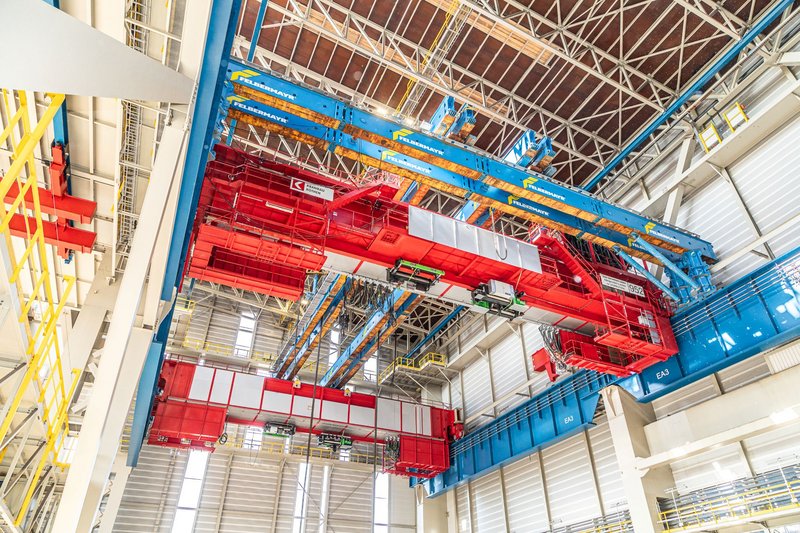
The charging crane has a lifting capacity of up to 500 tons and six hoists. It moves the scrap baskets filled with scrap steel to feed the electric arc furnace and handles the electrodes, which are almost three meters long and weigh more than two tons. Another crane with a load capacity of 265 tons supplies the furnace with molten pig iron. Both cranes came by ship from Germany to the Felbermayr heavy-duty port in Linz. When fully operational, the electric arc furnace is able to produce around 1.6 million tons of steel annually. With an assumed steel requirement of around 600 kilograms per vehicle, this corresponds to the quantity for more than two and a half million cars.
Little air upwards
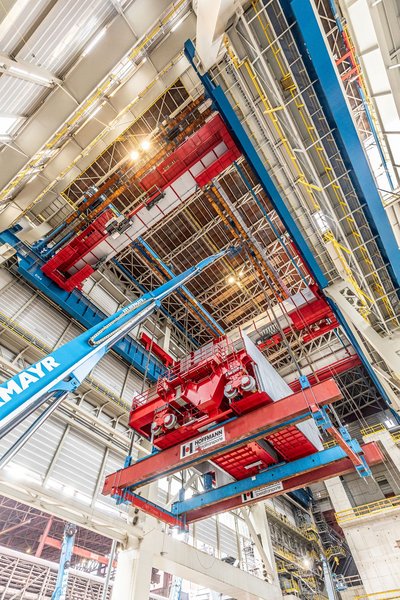
At a height of around 40 meters, Engineered Solutions built a specially developed strand lift system on the crane track girders. Its highest point was around 49 meters — with a clear hall height of just around 51 meters. As a result, as soon as the lifting system was set up, it became tight under the hall roof. With mobile cranes up to 650 tons and 57-meter working platforms, the engineers constructed the structure in sky blue, while construction site operations continued at full speed all around. “We had to be careful not to proverbially hit our heads on the hall ceiling with our lift system. Each set-up step had to be precisely planned and executed. At the same time, it was important to take sufficient space into account for subsequent strokes,” says Fuchs, describing the tricky starting position.
Heavyweights through the eye of a needle
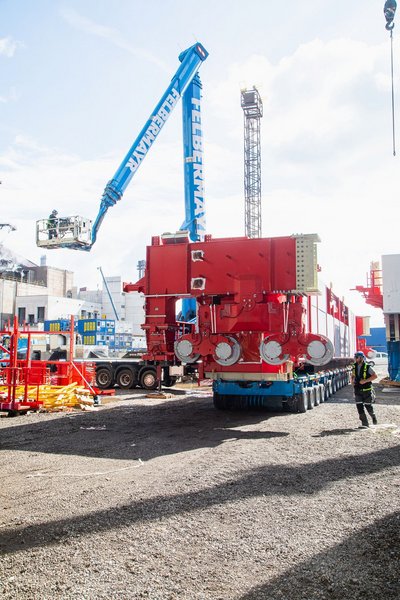
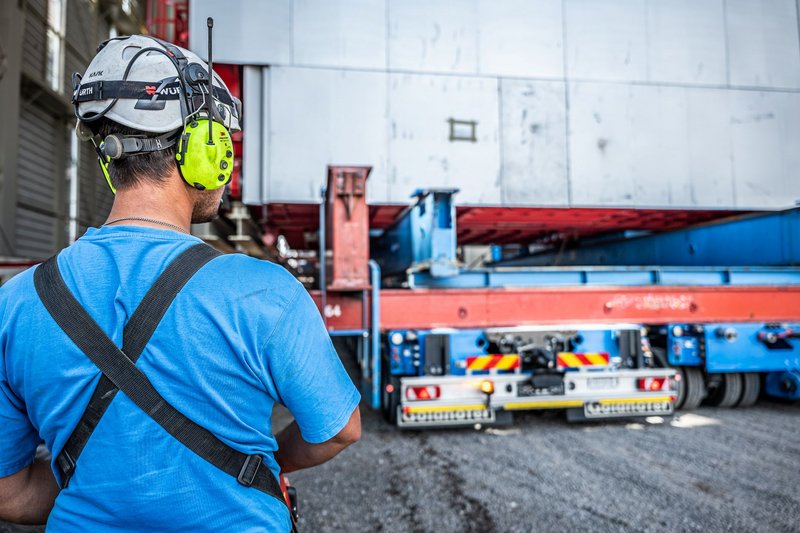
The two main carriers were brought into the SPMT hall. These each had 14 axle lines with two pendulum axles lying side by side — a so-called 2-file configuration. The main girders were then oriented obliquely so that they could fit through the constriction between the fixed crane track girders with centimeter accuracy when lifted.
Two strand lifters, each with a load capacity of 200 tons, lifted the main girders around 35 meters upwards. As soon as they had passed the crane track tracks, there was enough space to rotate the main girders into their installation position. Two moving systems with capacities of 200 and 400 tons were used for this purpose. The main girders were then lowered onto the rails, on which the charging crane later moved through the hall.
Cat learns to fly
Before the trolley was allowed to walk, it had to learn to fly first. The 205 ton trolley had to be lifted onto the crane bridge over the already assembled components. There, she later moves the hoist including the crane hook. The transport to the hall was previously carried out by a 10-axle SPMT vehicle in a 4-file configuration.
“We had to go up one floor with the trolley. In order to be able to lift the trolley over the main girders, we used a special lifting frame, which alone weighed 60 tons,” explains Fuchs. To this end, the Engineered Solutions team expanded the lifting system to four wire jacks, each with a load capacity of 200 tons.
Together, the four strand lifters lifted the trolley about 40 meters upwards. With the drop on the main carriers, the last of the three heavyweights also found a place. Starting in 2027, the electric arc furnaces will produce around two and a half million tons of CO2-reduced steel annually at the two voestalpine sites in Linz and Donawitz.