From floor to power plant — upper water channel renovated
December 17, 2025 | Moritz Glück
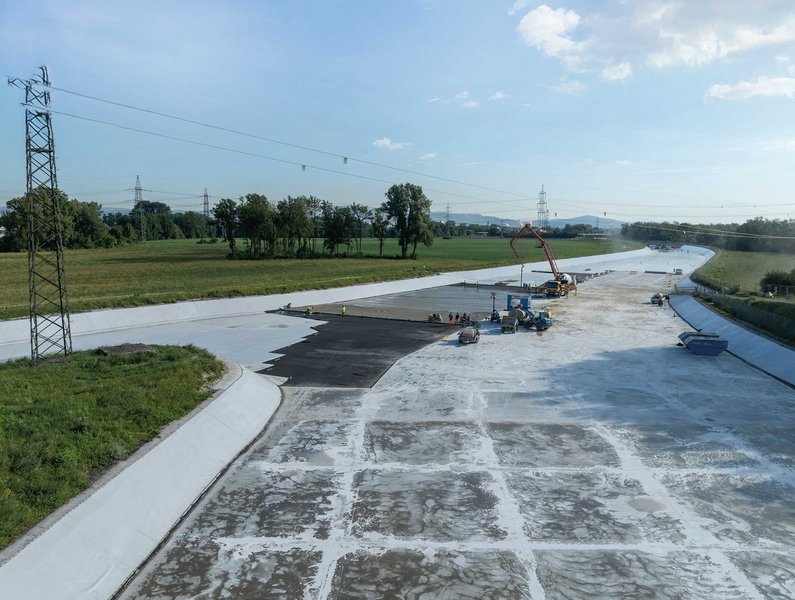
The Kleinmünchen hydroelectric power plant went into operation in 1978 and has been providing green electricity to around 20,000 households ever since. The water is taken from the Traun via a weir and fed via the upper water channel to the power house, where the connected generators of two pipe turbines generate an output of around ten megawatts. After more than four decades of operation and twelve years since the last preliminary renovation, a comprehensive repair of the sewer was now due.
Draining and dam construction
To carry out the work, the upper water channel was completely drained. For this purpose, Felbermayr's power plant construction specialists built several temporary dam structures — including landfill, protection and flood dams — as well as pumps and pump lines to discharge purification and rainwater. “Complete draining is the exception in power plant construction, because every hour in which no electricity is generated costs,” explains Felbermayr site manager Hubert Feuerhuber. With the dump dam above the confluence and a terminal dam in front of the turbine inlets, the water outflow could be specifically controlled. “This allows us to create defined, dry construction phases and at the same time provide sufficient reserves for precipitation events,” explains Feuerhuber.
Cleaning and preparation of the channel floor
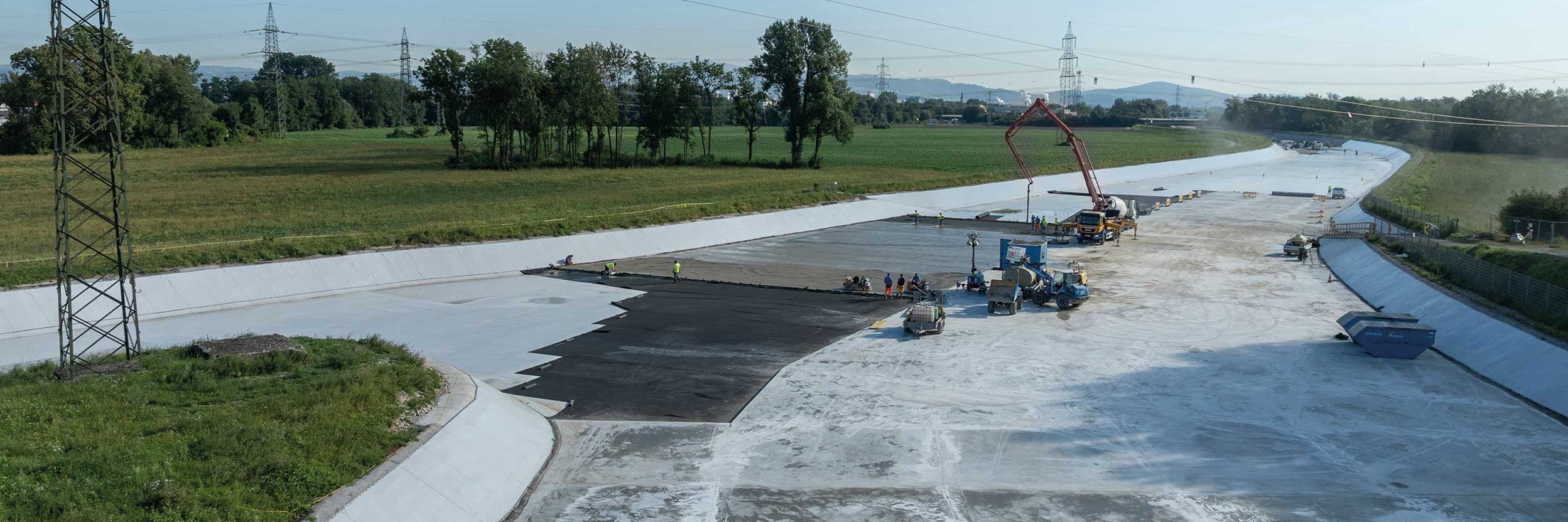
After the draining was completed, the extensive cleaning of the sewer began in July 2025. Excavators with long sleeves and attachment brushes as well as special high-pressure equipment were used to remove sediment, algae and deposits. “Our sequels only take effect when the sole is clean and free of residues. Preparation here is decisive for the quality of the new sole concrete slab,” emphasizes Feuerhuber. In parallel, a protective fleece is being laid over an area of around five hectares. This corresponds to the area of around ten soccer fields, notes Feuerhuber, impressively describing the dimensions. The fleece acts as a protective and separating layer and ensures an even layer of concrete.
Base concrete across the entire canal section The concreting work for
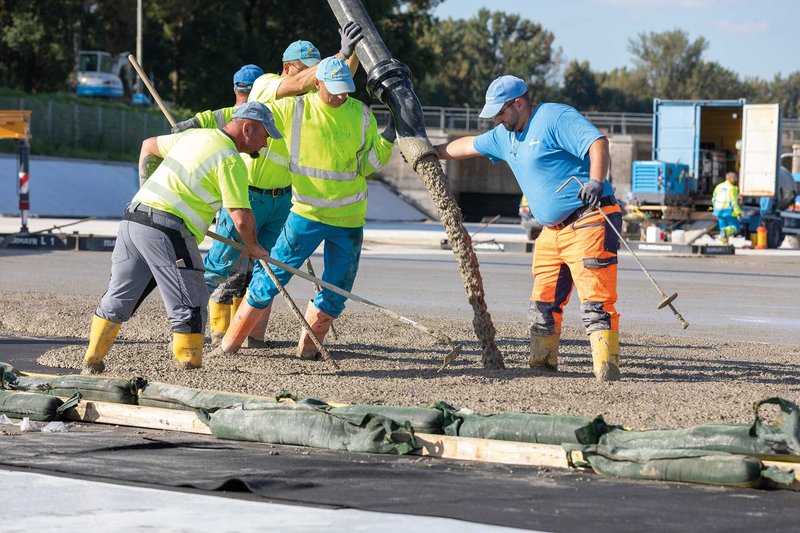
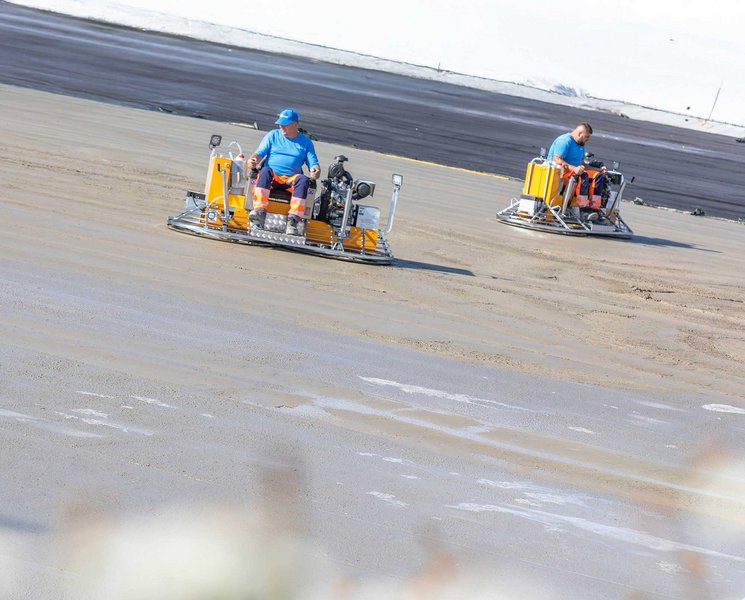
the new sole concrete slab then began. The three-kilometer renovation section has a sole width of between 7 and 63 meters. A 15-centimeter thick floor plate made from a total of 7,500 cubic meters of fibre-reinforced concrete was installed in this area. The concrete surface was then removed over an area of around five hectares using so-called battery shakers and smoothed out with ride-on wing straighteners. Access to the sewer was only possible from one side to bring in concrete, which is why the concrete was transported via specially equipped pump lines of up to 140 meters in length.
Accompanying repair and protective measures
In addition to concreting the sole plate, Felbermayr carried out extensive concrete repairs on the canal embankment walls and the weir system as well as on the power house building. During the work, power plant operations remained shut down so that Linz AG could carry out repair measures on turbines and ancillary facilities in parallel. In order to protect aquatic ecology, all fish and crab stocks were fished by external specialists during gradual damming. “For us, technology and ecology belong together: We plan construction processes in such a way that human impact is minimized and appropriate protective measures are effective,” underlines Feuerhuber.
Structural challenge
The use of fiber-reinforced concrete instead of conventional mat reinforcement on a PVC composite seal ensures an increased service life with reduced use of materials. For Feuerhuber, it is clear: “Fibre-reinforced concrete shortens installation times, reduces joint cracks and reduces reinforcement costs. This increases consistency in design and operation and is therefore an ideal example of efficient and sustainable construction in the power plant sector. ”
Heavy rainfall in July 2025 also put the project team to the test. In order to prevent damage to the existing sole due to rising groundwater, the installation of the sole concrete fields was accelerated. “Speed is decisive when the level rises, but the quality must not suffer as a result,” notes Feuerhuber.
Start-up before Christmas By mid-December 2025, all work should be completed and the canal should be dammed up again. The water then flows back to the powerhouse, where the two pipe turbines will once again generate around 70,000 megawatt hours of electricity per year — clean, sustainable and ready for the next decades thanks to Felbermayr's precision in construction. “Our goal is a permanently resilient building. The new sole plate provides the appropriate foundation for stable operation in the coming decades,” says Feuerhuber, looking to the future.