Precision work in the Mühlviertel
March 30, 2026 | Moritz Glück
The otherwise contemplative rural idyll of the village of just under 2,000 inhabitants in the Mühlviertel region was broken over two days in March when suddenly an entire residential building was hooked on the crane. “I've never experienced a move like this in my 36 years of work,” jokes project manager Herbert Gruber from the Linz Assembly Department. Preparation for the spectacular operation began the day before the actual hub.
Limited space for large equipment
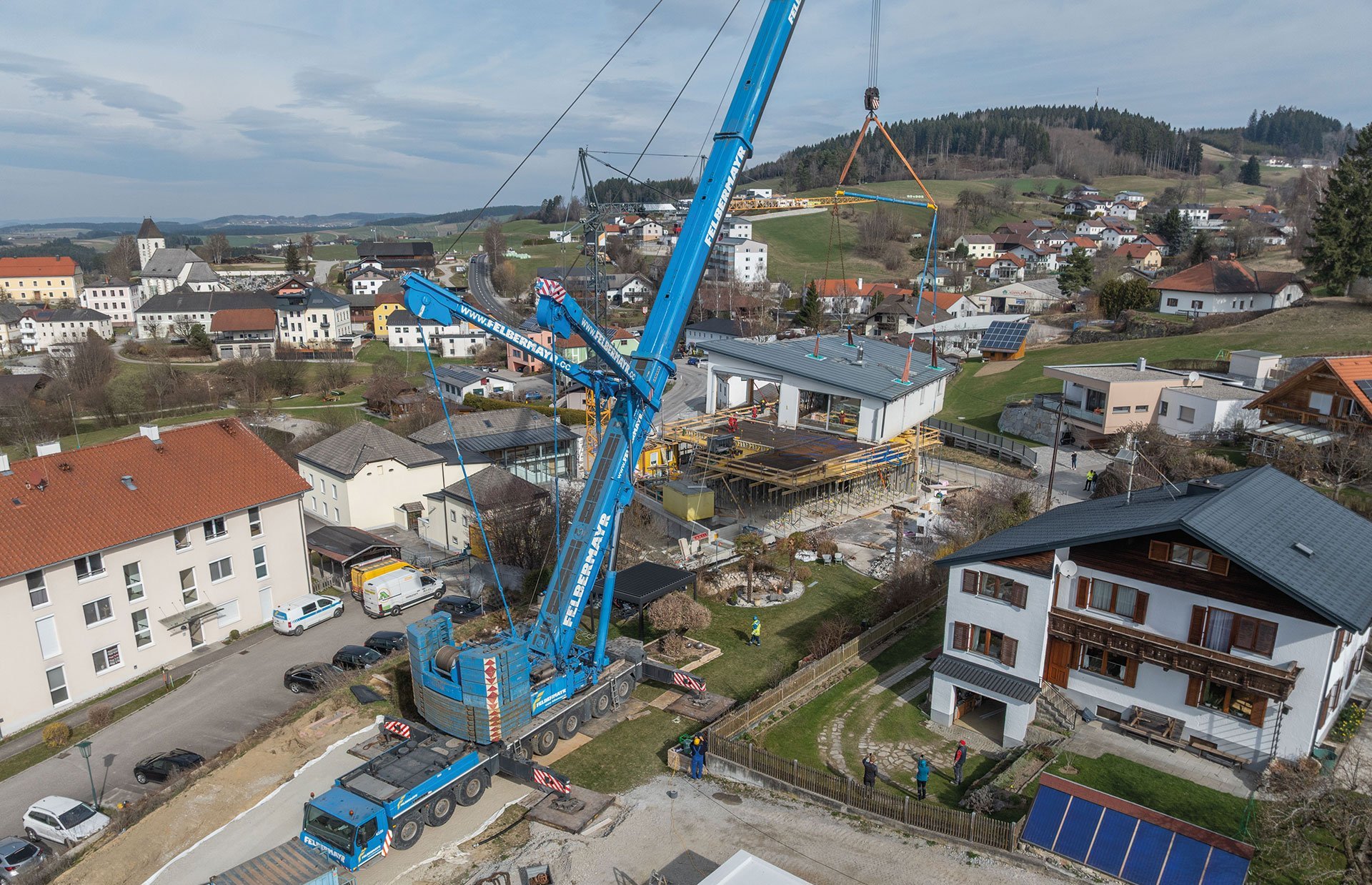
Even before the crane could start working, improvisation was required. Access to the property proved to be a decisive hurdle. Narrow paths and limited space left little room for heavy-duty technology. Where children normally go to school, a mobile crane weighing around 115 tons pushed itself across the school parking lot. It was only by building an access road of around 100 meters long that the device could be brought into position at all.
Around noon, the LTM 1150 mobile crane was set up — equipped with 165 tons of full ballast and tele-bracing. “Projects like this start long before the actual hub. Preparation determines whether everything works smoothly in the end,” explains Gruber and continues: “Tight spaces and the desire to leave everything unharmed required the utmost care right from this stage. ”
A house on a hook
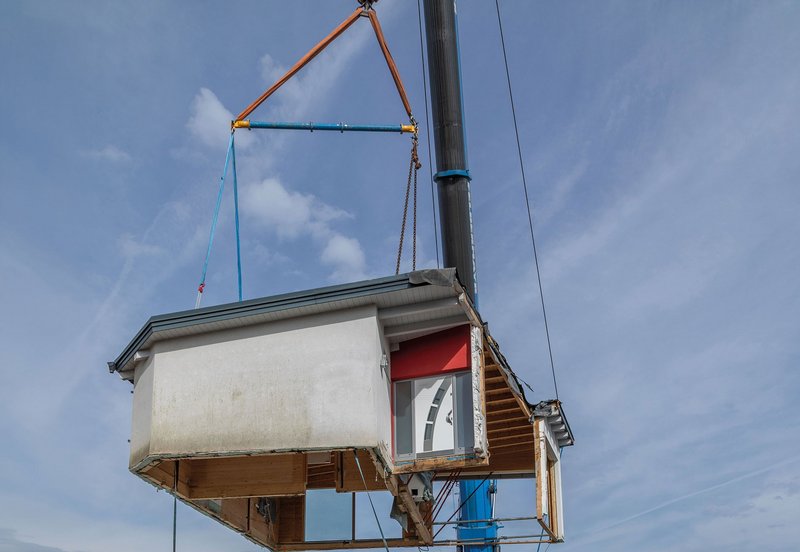
On March 25, the real highlight followed: the hub of the wooden house. What may look like a simple lifting process to outsiders is in fact a highly complex process. First, it was necessary to determine the exact center of gravity of the building — no trivial task with such a structure. “We raised the house a bit over and over again, seven to eight times in total, until it was clear how the load was distributed. Only then were we able to balance it exactly,” says Gruber. Chain hoists, which were attached to the side of the building, were used to finely adjust the orientation until it was exactly “in measure.”
Special solutions for sensitive loads
Particular attention was paid to protecting the building fabric. Instead of conventional round slings, specially purchased, extra wide slings were used. These distribute the load over a large area and prevent damage to the wood structure. The building was carefully analysed in advance together with structural engineers. Anchor points were defined, the focus was calculated and all lifting processes were planned in detail. In parallel, numerous consultations took place with construction companies and carpentry — an interplay of many trades that ultimately makes the difference.
Precision down to the last millimetre
When the house was finally perfectly balanced in the belts, the actual precision work began: The crane swung the construction, which weighs around 25 tons, by more than 180 degrees towards the new foundation. The building was led to its new position slowly, in a controlled manner and under the watchful eye of the residents. Millimeter by millimeter, the house was lowered onto the prepared foundation — a process that required the crane operator's finest dexterity.
Planning as the key to success
Despite the extraordinary task, the project went without complications. For Gruber, the reason is obvious: “The biggest challenge in this case was not technical but perfect and seamless preparation. If all steps are carefully planned in advance and the collaboration works, even an exceptional hub like this follows the same rules. ”
A new chapter
The residential building looks back on a long history: For decades, it was more than just a building — it was a home. People lived, worked here, memories were created. Part of the house has already been demolished, but the owner deliberately decided against a complete new building. Instead, the familiar should be retained — using cranes provided the solution.