Duet of steel
May 25, 2026 | Moritz Glück
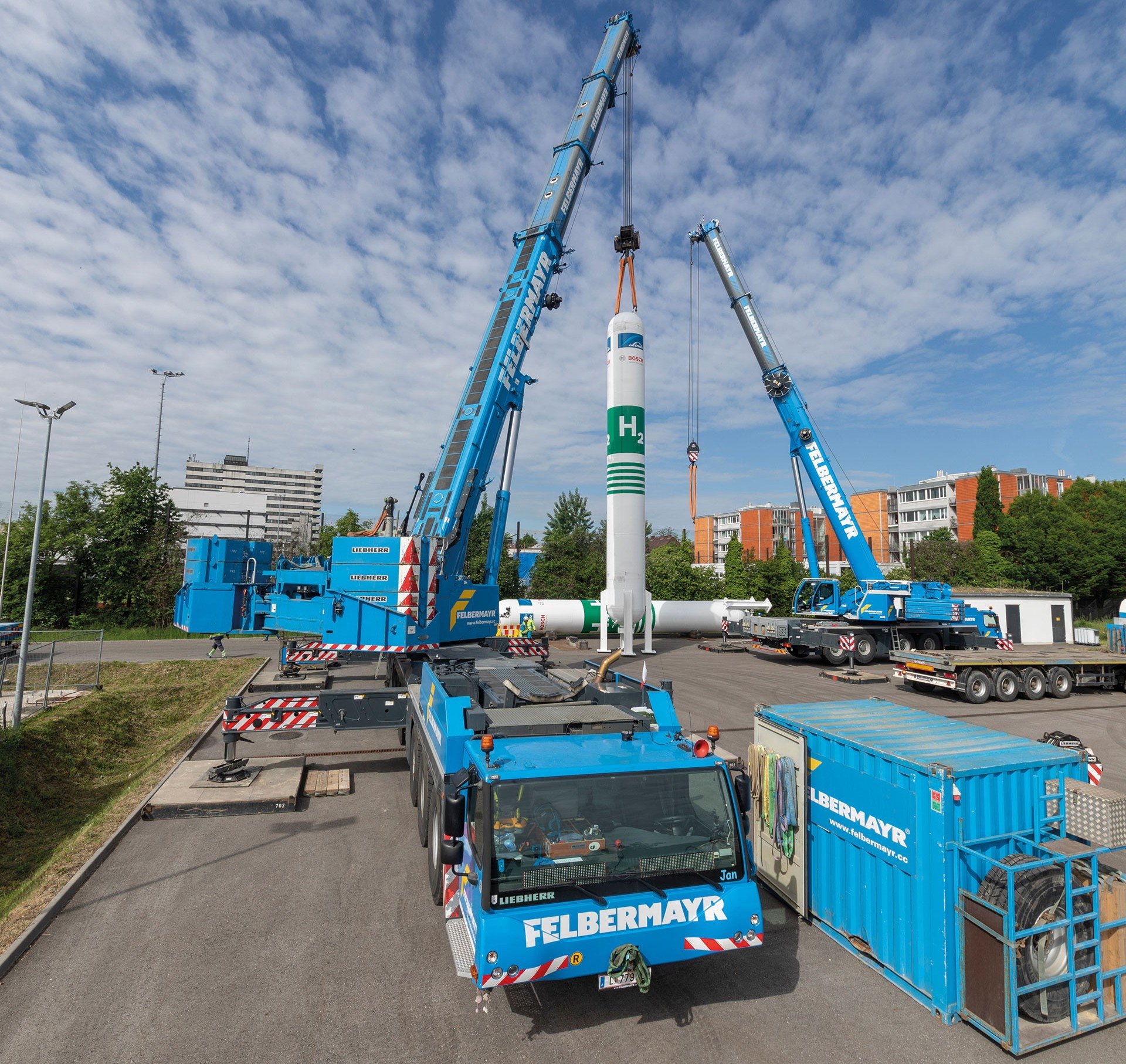
At the beginning of the year, Felbermayr took over abnormal load the two tanks from Kreuztal in North Rhine-Westphalia to Linz. These were delivered on an eight-axle semi-low loader before the two containers were unloaded and temporarily stored at the company premises. The tanks could only be set up after the required certificates had been received.
Planning with vision
Preparations for the subsequent lift and assembly began with interim storage on the factory premises. This was because the two colossi had to be positioned in such a way that sufficient space was retained for the cranes. “Even during interim storage, it was clear that the storage space for the two containers should not affect the cranes' standing space later on. The entire logistics therefore had to be planned with particular foresight,” explains Thomas Pamminger, Head of Crane and National Transport in Wels.
The two containers, which are around 18 meters long and around two meters in diameter, will provide the necessary infrastructure for various hydrogen applications in the future. This creates a decisive building block for the development and testing of future-oriented energy solutions at the Bosch Engineering Center site.
In the tandem lift
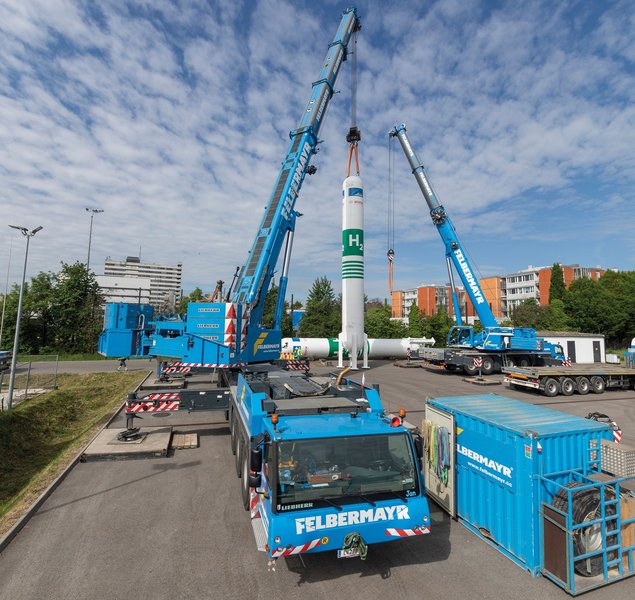
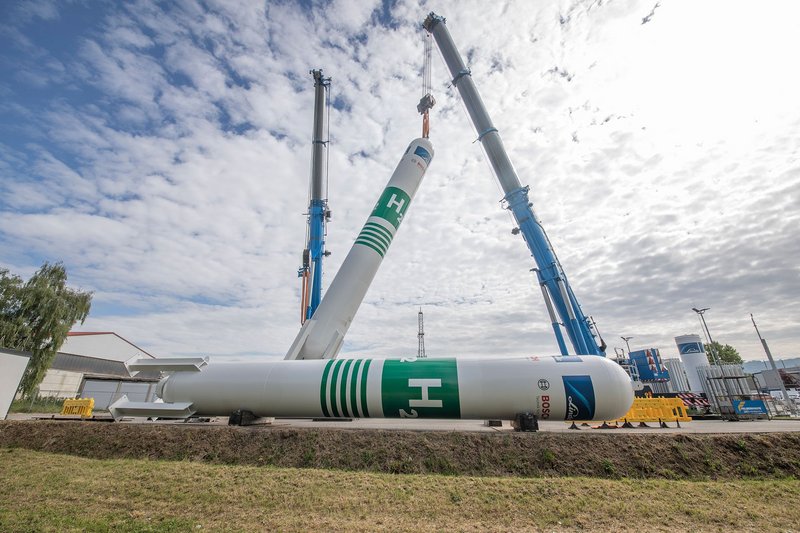
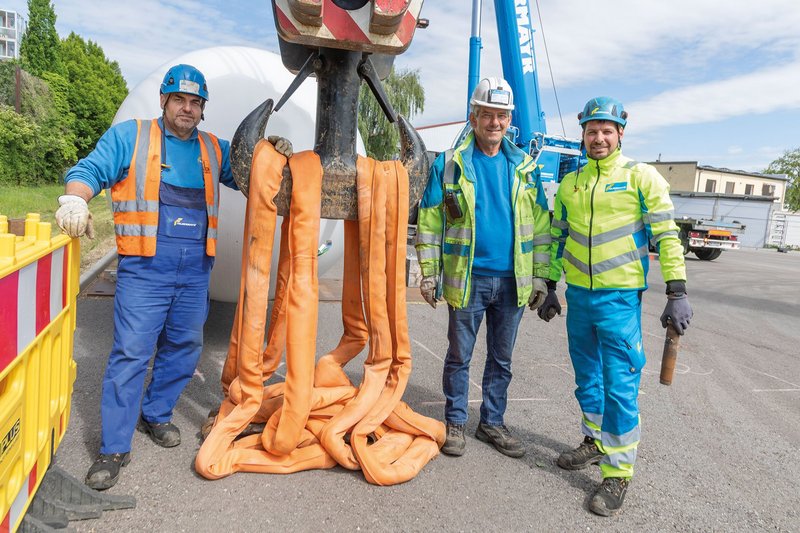
across locations, the crane experts from Wels and Linz mastered the lift with a 650-ton and a 160-ton mobile crane. The 650-ton truck was provided by the Linz branch. While the main crane was carrying the load, the auxiliary crane took over the controlled rotational movement of the tank. The process required maximum precision. First, both cranes lifted the first container. The auxiliary crane then released its rope in a controlled manner and guided the tank step by step from the horizontal position to the vertical position. Only then was the main crane able to place the container onto the bolts in the foundation with millimetre accuracy. Special shackles and slings were purchased specifically for the lifting work in order to be able to safely pick up the loads accordingly.
“Setting up gas tanks is almost part of our daily business. However, we usually move significantly smaller containers. This time, there were two tanks of this size on the agenda,” says Pamminger, describing the “great” effort. Finally, both tanks were bolted and bolted by the customer's fitters. After around three hours, both containers were erected and rise up into the sky, visible from afar.
For Pamminger, however, the project is important beyond technical performance: “The client has been with us as a reliable partner for many years. It is therefore all the better to see that our work will contribute to the further development of hydrogen technologies in the future. Projects like this show what role modern energy sources can play in the future. ”